EsoLink
One smallholder farm grows too little to fill a wholesale order. EsoLink joins many harvests into one, so a buyer can order the quantity they actually need — and no crop is left unsold. I designed it and I built it.
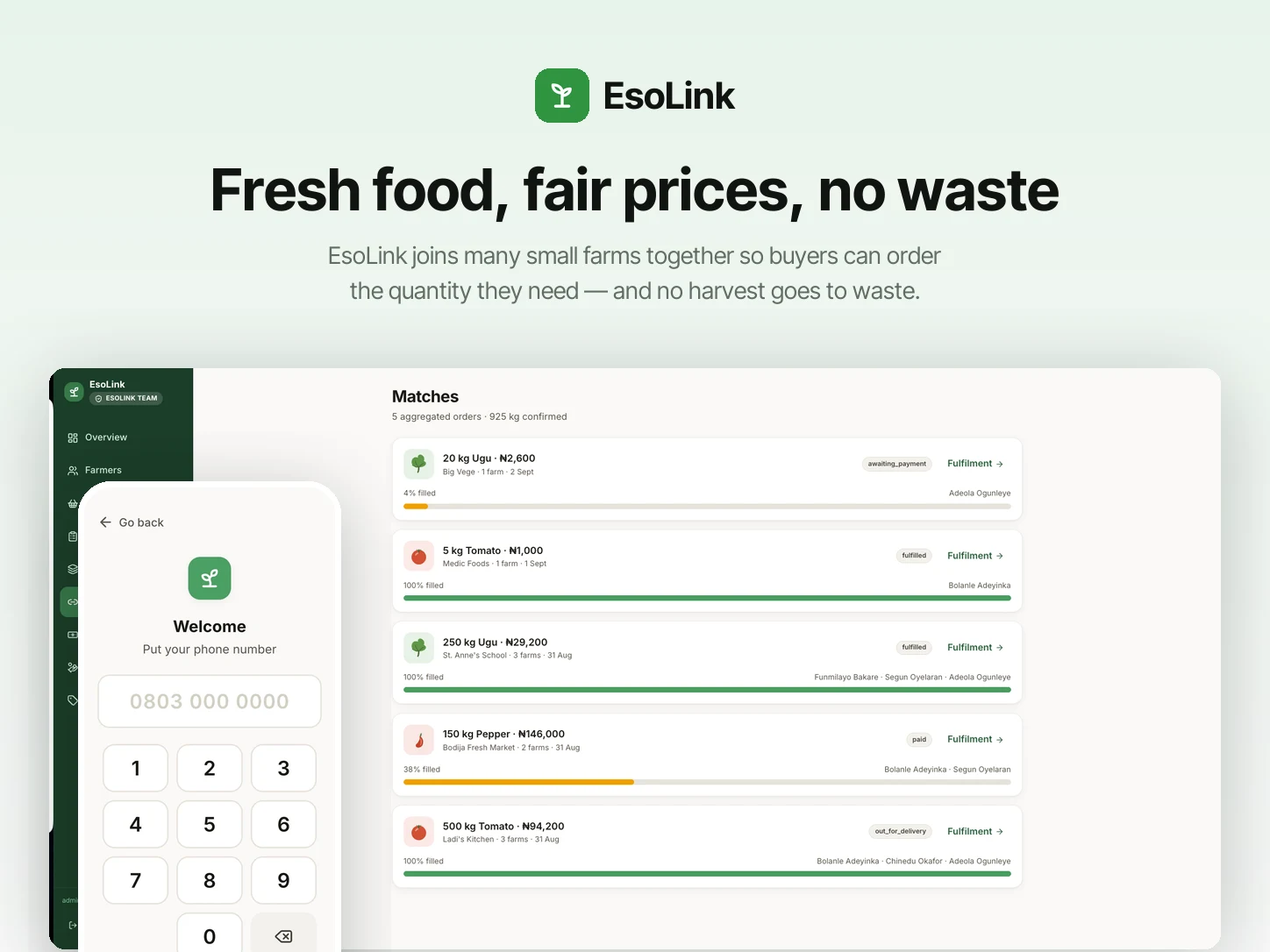
Overview
A restaurant in Ibadan needs 500 kg of tomato by Friday. A farmer two towns over has 40 kg ready now. Neither can do business with the other: the quantities don't meet, and no single smallholder can fill a wholesale order alone.
So the gap gets filled informally. Middlemen walk the farms, buy small, consolidate, and sell the aggregated lot at the margin they choose. Farmers take whatever price is offered on the day — or watch the harvest spoil.
EsoLink is that aggregation, done in software and done in the open. Fresh food, fair prices, no waste is the whole product in six words.
This was not a design handed to engineers. I defined the product, designed the three role apps, wrote the matching engine, modelled the database and shipped it to production — 29 commits between 30 August and 19 October 2026.
Three users who must never see the same screen
"Marketplace" sounds like one product. It is three, and the gap between them is the real design problem — a farmer on a shared Android phone and an operations lead on a desktop have almost nothing in common except the kilogram.
The farmer — a phone, and not much else
- Identity is the phone number. No email address, no username, nothing to lose access to
- Adding produce is five steps, every one of them a tap
- Installs to the home screen as a progressive web app, so it opens with its own icon and no browser chrome — which is how a farmer will actually use it
- The constraint behind it — assume a cheap Android, an intermittent connection, and a user who has never filled in a web form
The buyer — a quantity and a deadline
- Posts what they need and when they need it, and does not choose farms
- Sees which farms filled the order, and at what price, only after it is assembled
- The decision — buyers were never given a catalogue to browse. Browsing 32 listings to assemble 500 kg by hand is the job EsoLink exists to remove
The team — the only people who see both sides
- Runs the matching engine, confirms payment, and moves an order through fulfilment
- A human presses the button. Nothing auto-matches, and only a person confirming a bank transfer takes stock off the market
- The cost of that choice — it does not scale past a pilot, and it is correct anyway. The first time the engine allocates somebody's harvest wrongly, a person needs to have been in the loop
Each area carries its own navigation and accent colour — farmer green, buyer orange, team teal — so nobody is ever one tap from a screen that was not built for them.
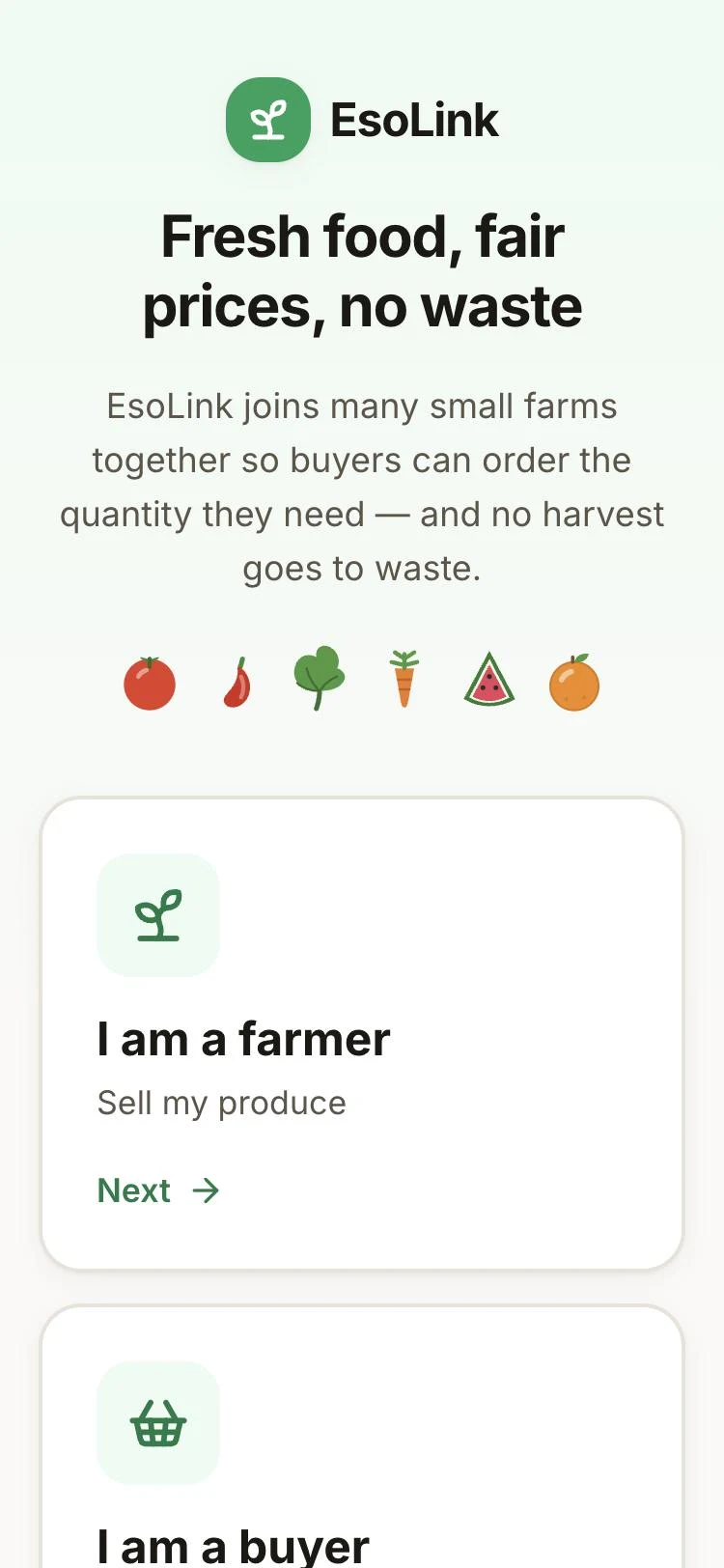
The door, and the first thing behind it. One question before anything else — are you selling or buying — because the two products share no screens after this point.
Designing for a phone number
The farmer sign-in is the screen I rewrote most, and the one that best explains the whole product's posture.
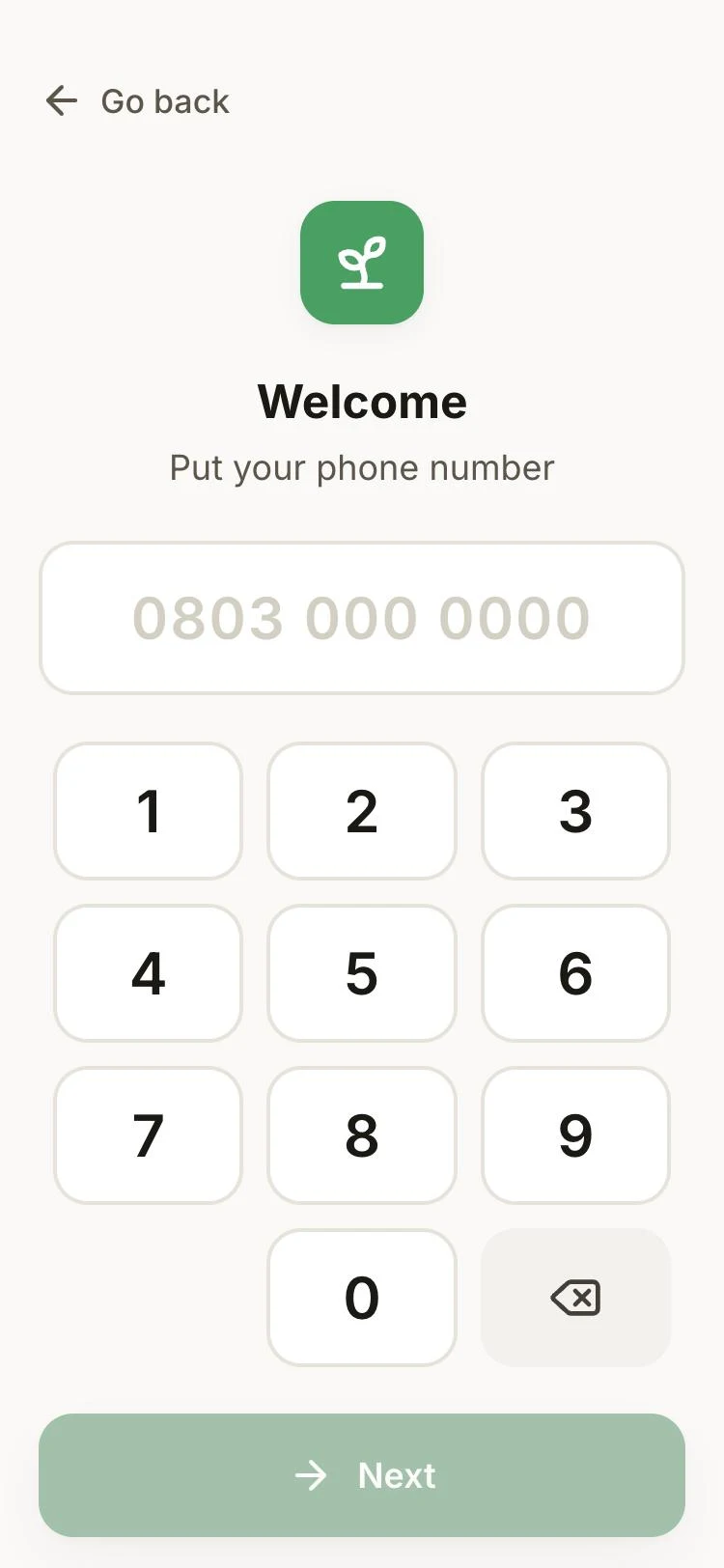
The keypad is drawn, not borrowed
- The screen renders its own numeric keypad instead of waiting for the system keyboard to appear
- Targets are large, fixed in place, and cannot shift under a thumb mid-entry the way a soft keyboard does
- The placeholder is a real Nigerian number shape — 0803 000 0000 — so the format is shown rather than explained
- The prompt reads "Put your phone number", not "Enter your mobile number". Plain is not condescending; it is faster
A four-digit PIN, and an honest label on it
- A farmer chooses a 4-digit code. It is guessable, and throttling it to five tries per fifteen minutes does not change that
- The throttle counter lives in memory, so it resets on every deploy — written down in the code at the line where it matters
- Why ship it anyway — the fix is a phone OTP, which costs money per message and needs an SMS provider contract. Until there is a budget line, the weak thing that works beats the strong thing that doesn't exist
- What I refuse to do is call it secure in a case study. It is a documented cut with a named replacement
The decision I'd defend hardest: it is not AI
Everything in this category is sold as AI matching. EsoLink's engine is a deterministic algorithm in a single commented file, and that is a product decision, not a shortcut.
- A learned model ranking farms by some blend of price, distance and reliability
- Allocations that are optimal on average and unexplainable individually
- A farmer asking why they got 120 kg of a 500 kg order, and the only available answer being "the model chose"
- Filter — same crop, in stock, ready before the deadline, close enough to deliver
- Rank — cheapest first
- Allocate — greedily, until the order is full
- Report — the total, the fill percentage, and an honest shortfall when it came up short
Every allocation can be read back line by line. That is the entire argument. In a market where the incumbent is a middleman nobody trusts, a system that cannot explain its own split has not replaced the middleman — it has only made him harder to argue with. Eleven tests cover the engine, including the worked example from the brief: a 500 kg tomato order filled from three farms at ₦94,200.
The same restraint applies at the other end of the product. Farmers enter their own expected harvest dates and the engine matches against them. Nothing is forecast, because forecasting from listing history would genuinely be machine learning — and a wrong prediction about a harvest is a farmer planting against a number I made up.
The feature I shipped by removing it
EsoLink Voice let a farmer list produce by speaking in Yorùbá. It was fully built — parser, tests, screens — and then taken back out.
- Speaking is the obvious answer to a user who may not read
- It demos beautifully, and it is the single most quotable thing in the product
- Built end to end against the browser's own speech recogniser — no provider cost, no key, nothing to negotiate
- Tried on actual Yorùbá, the recogniser did not understand what was said. Chrome has no dependable Yorùbá model
- A microphone that mishears a price is worse than no microphone — the farmer either notices and stops trusting the app, or doesn't notice and lists their crop at the wrong figure
- Removed as a single clean revert, so the whole feature returns the day a provider with real Yorùbá speech-to-text is wired up
Shipping is not the only way to finish something. Voice is still the right feature; the infrastructure under it is not ready, and shipping it anyway would have put the cost of that gap on the person who can least afford it. It sits one revert away with a named candidate provider and a budget line attached — which is a different state from "cut".
Three languages, and the limit of translating
- The farmer app runs in English, Yorùbá and Nigerian Pidgin, chosen with a row of large buttons on the very first screen and again on the farmer's home
- Pidgin earns its place because it is the language most likely to be shared by everybody in the pilot, including farmers who moved to Oyo from elsewhere
- Only the farmer app is translated. Buyers are business users and the team reads English, so translating those areas doubles the copy for no gain
- Both translations are unreviewed drafts, labelled as such at the top of their own files, and no real farmer sees either until a fluent speaker has read every line — agricultural and money words are exactly where a translation goes wrong
And the honest limit, which belongs in the case study because it belonged in the brief: the premise is a farmer who may not read at all. Translating text only changes which language they cannot read. What this serves is the farmer who reads Yorùbá or Pidgin but not English — a good reason to build it, and not the same claim.
"Fulfilled" is three different facts
An aggregated order is three farms. Collapsing that into one status is how a farmer ends up unpaid for produce that did arrive.
Every contribution keeps its own record, and the numbers are never merged:
- agreed → still available → collected → delivered → confirmed by the buyer
- Record a collection lighter than expected and a discrepancy opens on the spot — the agreed quantity is left exactly as it was, because overwriting it erases the evidence
- The team's figure and the buyer's figure are stored separately. The difference between them is the thing worth catching, and averaging them away destroys it
- Confirming payment is one database transaction with row locks, so a double-click cannot take the same stock off the market twice
Making the engine visible
The team's view is where an abstract allocation becomes something a person can check, override and explain on the phone to a farmer.
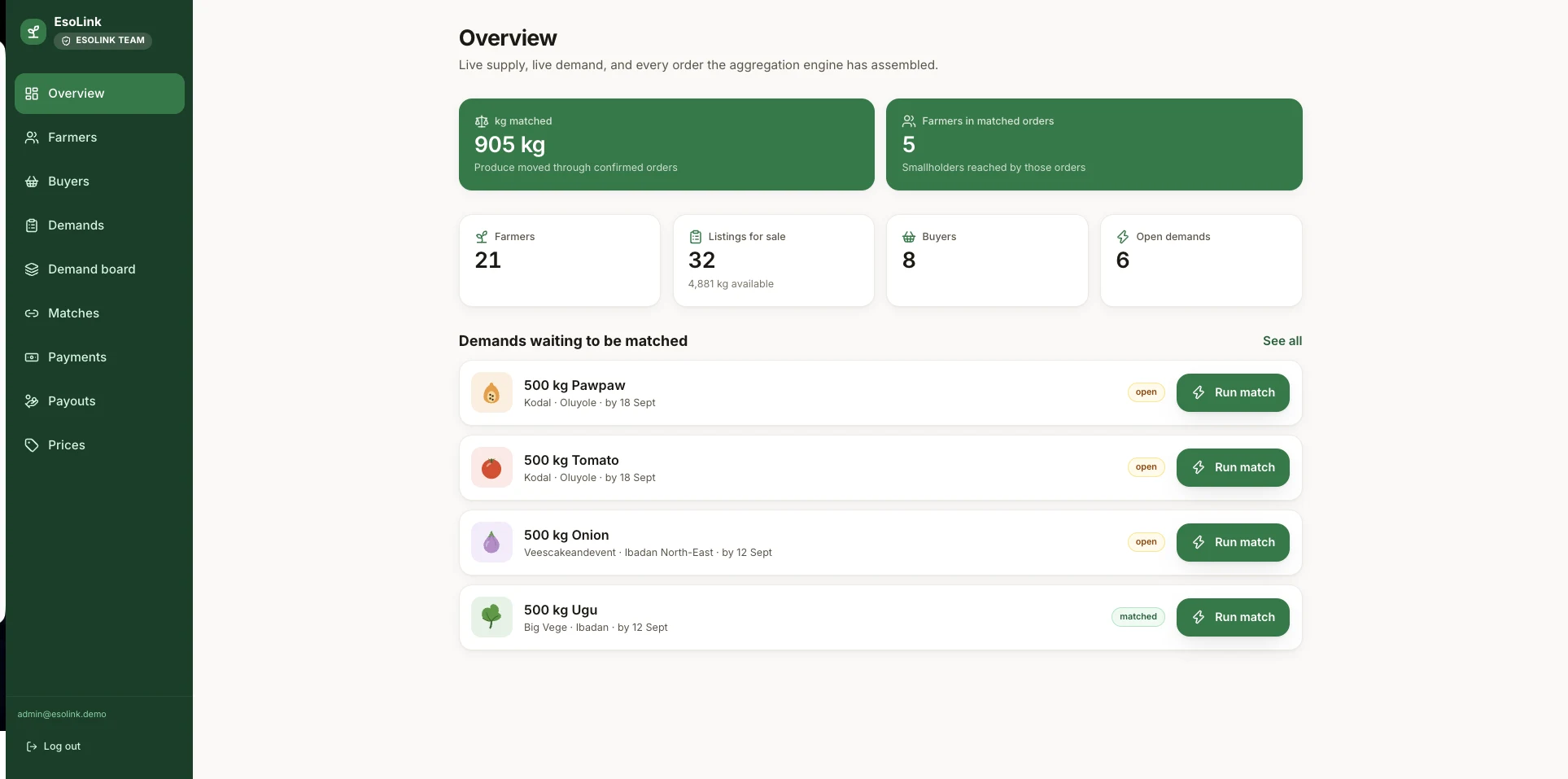
Supply, demand, and the gap between them on one screen. Every open demand carries a Run match button, because a human starts the engine — it never runs on its own.
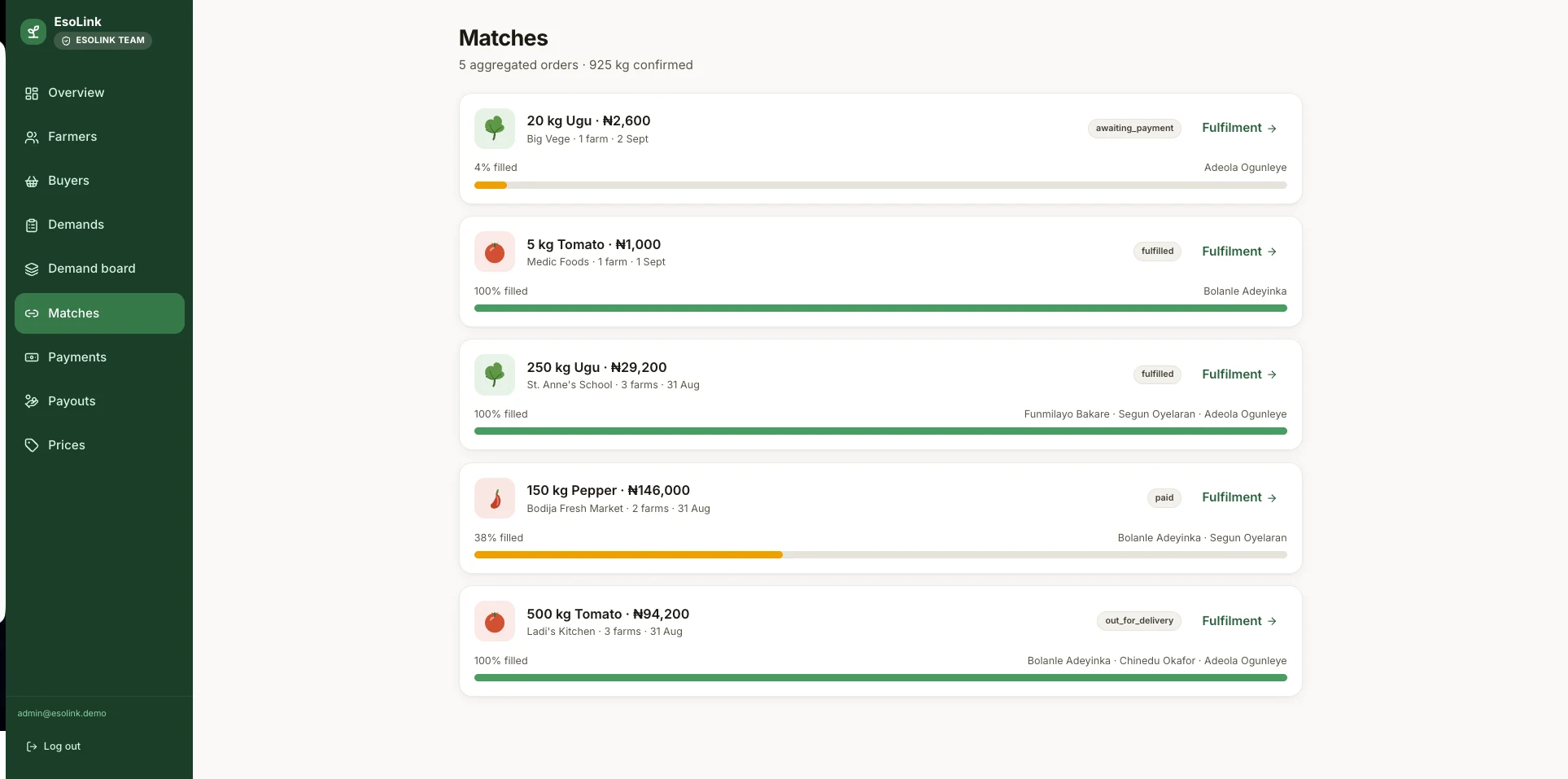
The product's whole thesis in one row. 250 kg of ugu, 100% filled, three farms named underneath. A partial fill shows its real percentage in amber rather than rounding itself up — 4% filled is information the team needs that evening, not a failure to hide.
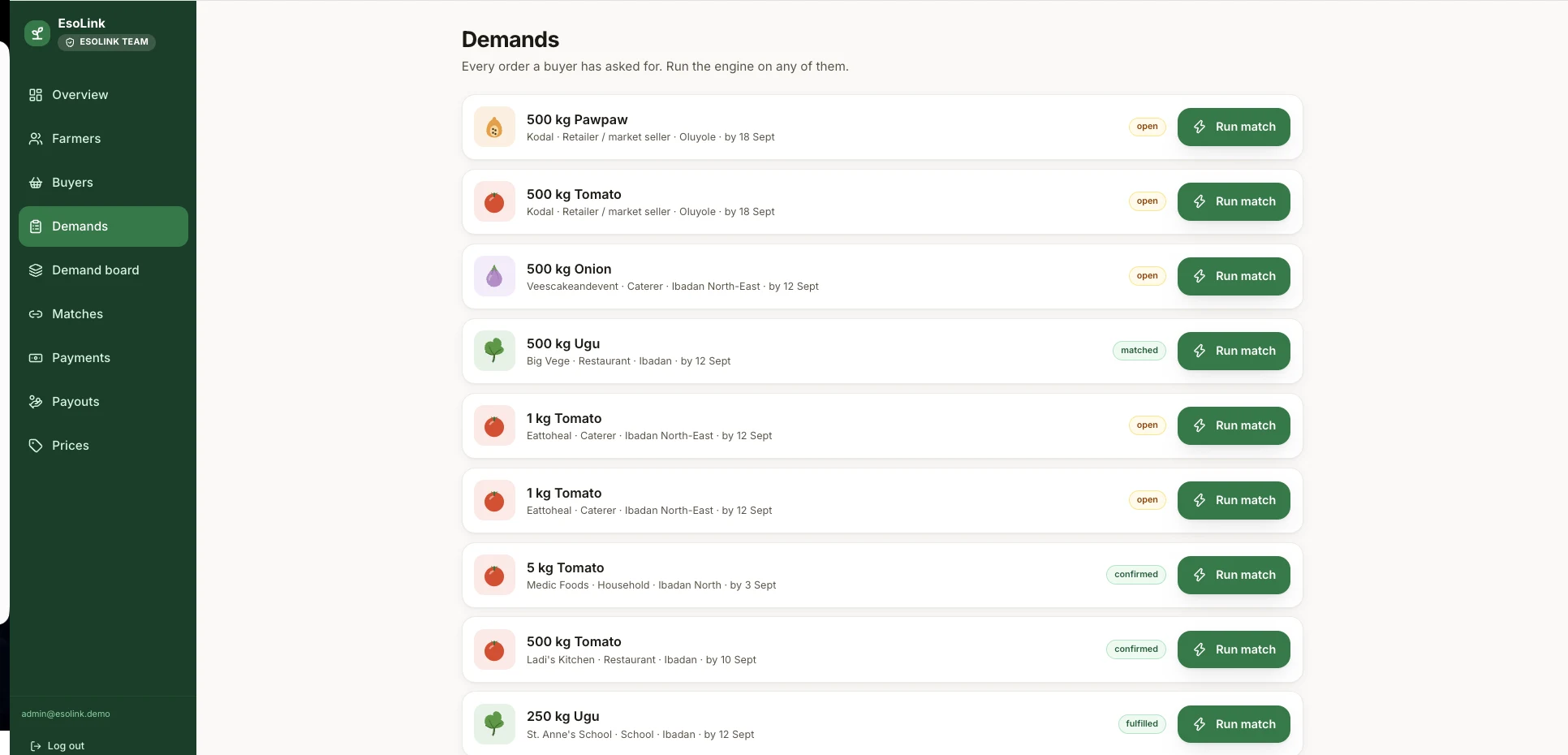
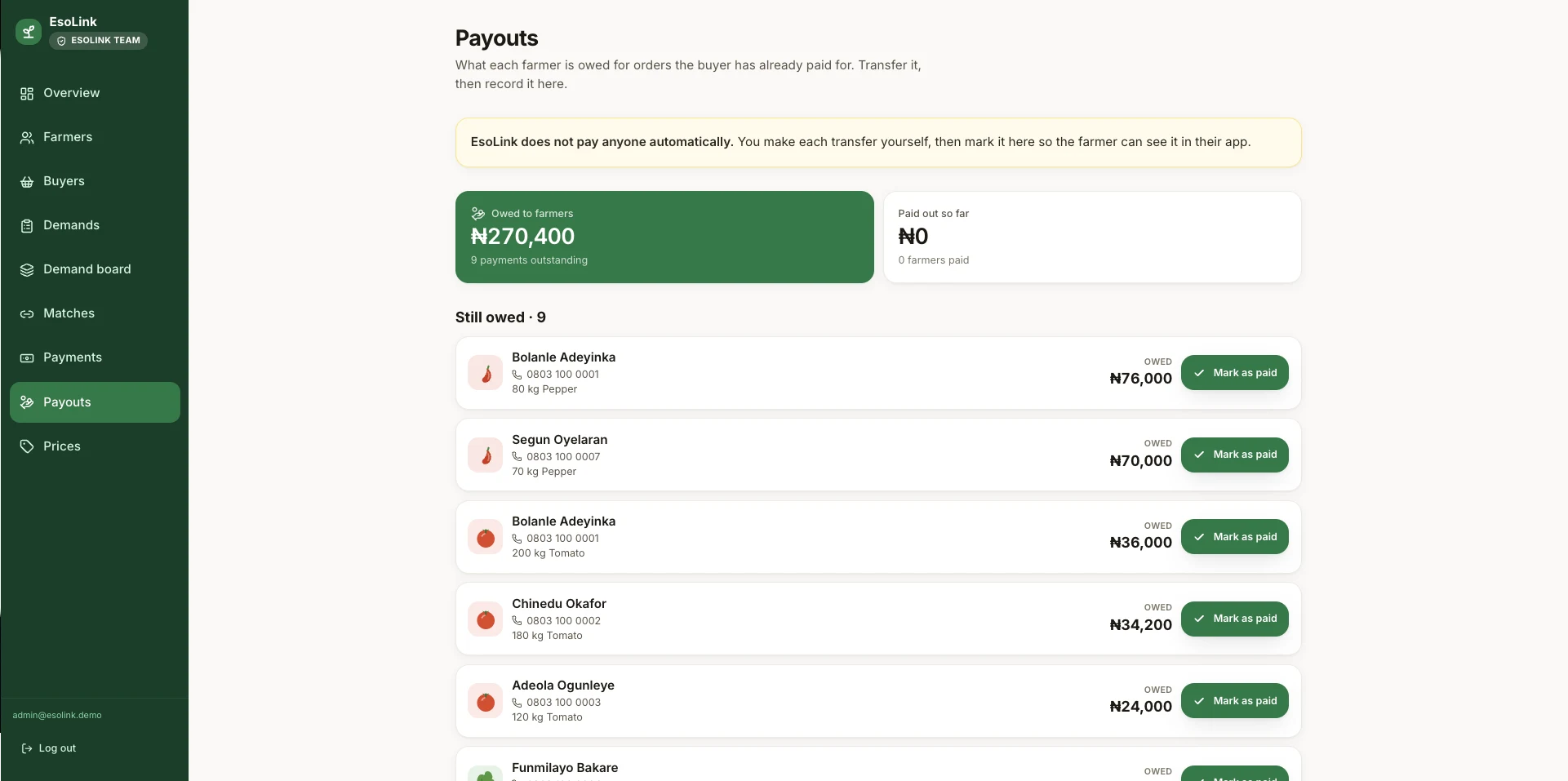
Demand in, payouts out. Because one order splits across farms, the payout screen is the only place that answers the question a farmer will actually ring about: of that order, what is mine? Screens show seeded demonstration data, not real users' records.
Why the boards can never disagree
- Farmers see orders nobody can fill near them, with the shortfall in kilograms, and can tap I can supply this. The buyer stays anonymous, as everywhere else
- Farmers can declare a harvest weeks ahead — and a declaration is not a listing. It holds no photo and no price, it is not in the matching pool, and it cannot be sold, because nobody has verified that the harvest exists
- Buyers get a supply board separating what is available now from what farms say is coming, with an I would take this that reserves nothing and says so on the button
- Every availability number on all four screens comes from the same matching engine. There is no second algorithm, which is the only reason a board can never contradict the match a buyer is shown
The day I deleted the demo
EsoLink launched with seeded data — invented farmers, invented buyers, invented completed orders. It made the dashboard look like a working business.
On 19 October I deleted all of it from the live database. The aggregation engine now has almost nothing to show, because there are no completed real orders yet, and the dashboard is close to empty.
That is the correct state. The moment numbers from a dashboard go into a funding application or a team meeting, invented rows stop being a demo and start being a claim. A product that looks busy with data you made up is a lie you eventually tell yourself — and the seed script still exists, for a scratch database, where it belongs.
Where it stands
- Live in production on Vercel, with continuous integration gating every push to main
- Three role areas shipped: farmer PWA, buyer app, team dashboard
- Deterministic matching engine under eleven tests, plus database-level tests that roll themselves back so they can run against live
- Trust Chain and Demand Bridge shipped; EsoLink Voice built and deliberately held back
- Every known limitation documented in the open, at the line of code where it matters
What I learned
- In a market built on mistrust, explainability beats optimisation — a split you can read back is worth more than a split that is marginally better
- Designing and building the same product collapses the argument about what is feasible, and removes the excuse
- Naming a weakness precisely is cheaper than defending a vague strength
- A feature can be finished and still not ship — and leaving it one revert away is a design decision, not indecision
- Honest empty states are worth more than impressive fake ones
EsoLink has no payments, no logistics and no notifications. Money moves by hand, outside the app. These are scoped cuts rather than gaps — a pilot that proves aggregation works is worth more than a complete product that nobody has tested on a real harvest.